Are Emotions Contagious?
Short answer: yes. Moods spread from person to person, often without anyone noticing. The good news is that you have an immune system.
What’s going around
 The cold
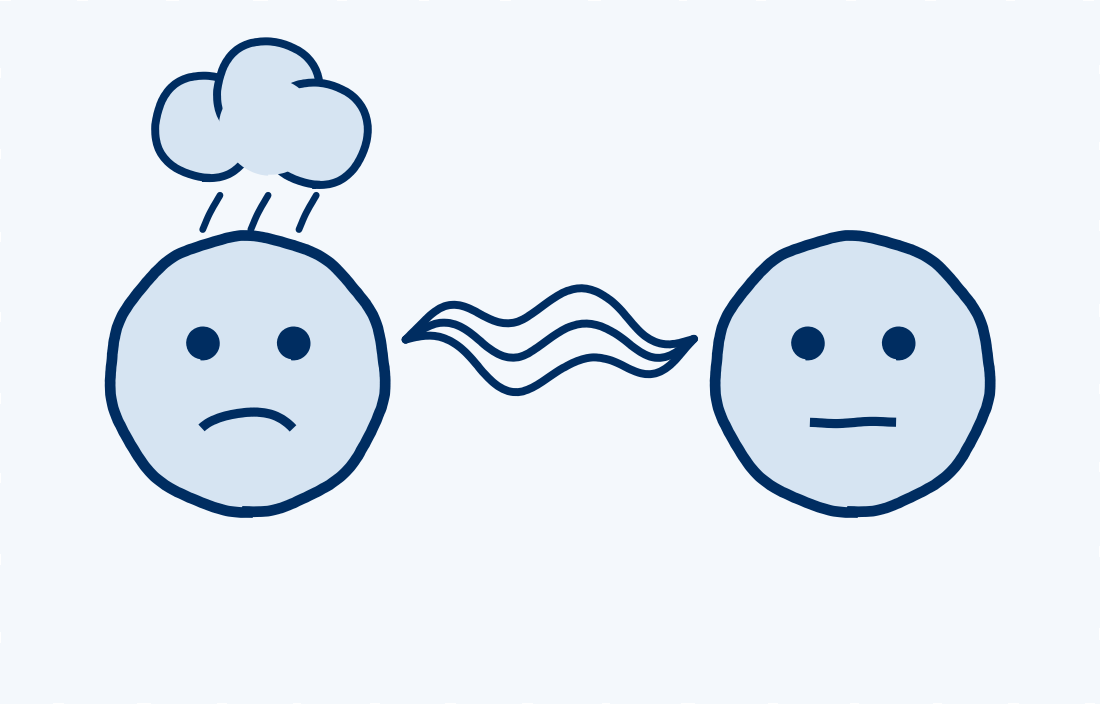
Stress spreads through teams. In a survey of 237 employees across 41 teams, people on teams where moods spread easily reported a bigger drop in wellbeing under stress. On calmer teams, the same tendency went with better wellbeing.
Hernandez Grande et al., 2025, Journal of Management & Organization The good stuff
Joy travels, even over video. People who listened to a partner describe a happy moment felt happier themselves, and you could see it on their faces. Anger and sadness spread too, but they barely showed. So on your next video call, don’t assume a calm face means an emotion didn’t spread.
Marx et al., 2025, Frontiers in Psychology
Leaders’ moods spread to their teams. Researchers pulled together 25 studies on leaders and emotional contagion and found a consistent pattern: leaders’ positive moods carry over to the people they lead, especially when those leaders are energizing and inspiring. That spread was also linked to how effective leaders were and how well their teams performed. Moods passed most easily when leaders and team members were already on the same emotional wavelength, and some people caught moods more readily than others.
Clarkson et al., 2020, European Journal of Social PsychologyReview of 25 studies

Gratitude is a habit worth catching. When leaders said thank you, employees started noticing what coworkers did for them and saying thanks more often. Their working relationships got stronger, too. The best part: you don’t have to wait to catch it. Start by noticing one thing someone did for you today and extend a thank you.
Locklear, Kane & Ehrhart, 2026, Journal of Applied PsychologyDo people notice when they’ve caught something?
Our Emotional Intelligence Appraisal asks people how often they do certain things. Two of the questions get at emotional contagion: how often you recognize other people’s feelings, and how often you realize when someone else is influencing your own emotions.
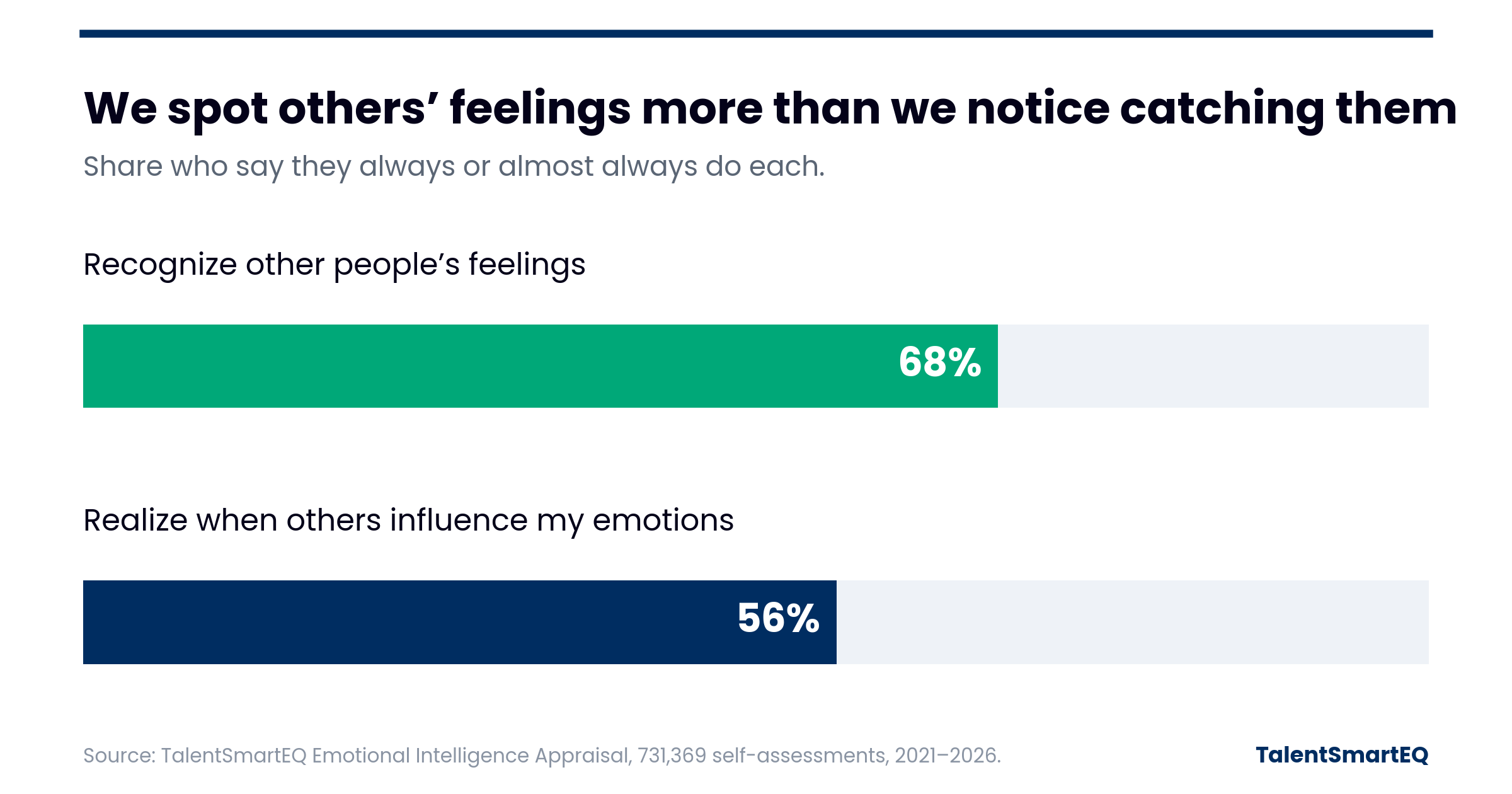
Most people say they’re good at reading others: 68% always or almost always recognize other people’s feelings. Noticing when someone else’s mood is rubbing off on you is harder. Only 56% always or almost always catch it, which leaves 44% who don’t consistently notice when they’ve caught someone else’s mood. In other words, it’s easier to spot a cold going around than to notice you’ve caught one.
Are you catching a cold, or taking your vitamin G?
- When your mood shifts, ask: is this mine, or did I catch it?
- Who are you catching moods from today, and who is catching yours?
- Take your vitamin G: notice one thing someone did for you, and say thanks.
TalentSmartEQ data: 731,369 Emotional Intelligence Appraisal self-assessments, 2021–2026. Items: “Realize when others influence your emotional state” and “Recognize other people’s feelings.”
Hernandez Grande, A., Farr-Wharton, B., Sharafizad, F., Darcy, S., & Gavin, M. (2025). Catching on: Work stress, employee wellbeing, and the moderating role of team-level emotional contagion. Journal of Management & Organization, 31(1), 346–359. doi.org/10.1017/jmo.2024.44
Marx, A. K. G., Sachs, D. F., Frenzel, A. C., & Schweizer, M. T. (2025). Emotional contagion in dyadic online video conferences: Empirical evidence based on self-report and facial expression data. Frontiers in Psychology, 16, 1546303. doi.org/10.3389/fpsyg.2025.1546303
Clarkson, B. G., Wagstaff, C. R. D., Arthur, C. A., & Thelwell, R. C. (2020). Leadership and the contagion of affective phenomena: A systematic review and mini meta-analysis. European Journal of Social Psychology, 50(1), 61–80. doi.org/10.1002/ejsp.2615
Locklear, L. R., Kane, M. E., & Ehrhart, M. G. (2026). Grateful leaders and attentive followers. Journal of Applied Psychology. doi.org/10.1037/apl0001398
Copyright 2026 © TalentSmart Inc. All rights reserved.